Offshore software development rates vary based on numerous factors: from the provider location to the tax policy in the target country. So, how do you choose the destination for your business? This article compared average costs in different regions and included information to help you choose the best country to outsource software development.
Key Takeaways:
- Offshore software development rates vary significantly by country and region. Factors such as labor costs, talent availability, local market conditions, and technical expertise create substantial differences in hourly rates across Eastern Europe, Asia, Latin America, and other outsourcing destinations.
- The lowest developer costs per hour doesn’t always deliver the lowest overall project cost. Developer experience, productivity, communication efficiency, code quality, and management overhead have a greater impact on total project expenses than hourly pricing alone.
- Eastern Europe continues to offer one of the strongest value propositions. Countries such as Ukraine, Poland, and Romania combine highly skilled engineering talent, strong technical education, competitive rates, and excellent collaboration with international clients.
- Choose an outsourcing destination based on your business priorities. While Asia often offers the lowest rates, Latin America provides excellent time-zone alignment for North American companies, and Eastern Europe is widely recognized for its balance of quality, communication, and cost efficiency.
- Look beyond hourly rates when evaluating offshore partners. English proficiency, cultural compatibility, security practices, legal protections, scalability, and project management capabilities are critical factors that influence delivery quality and long-term success.
- Compare countries using total business value rather than pricing alone. The best offshore destination is the one that aligns with your technical requirements, budget, collaboration preferences, and long-term growth strategy—not necessarily the country with the cheapest developers.
How Did the Outsourcing Rates Fluctuate Over the Last Year?
Offshore software development rates have always been sensitive to the slightest political and economic changes in the world. Considering the current situation, we analysed the recent insights on the development costs to help you understand, how much would you pay to hire developers for big data, AI, IoT and other innovative projects.
Over the last year, in several regions, prices for IT engineers have experienced slight increases. This growth was influenced by such factors as tech talent demand, economic situation, and the latest geopolitical events.
In Asia, India and Vietnam, which were known as the biggest hubs for cheap product development, increased their rates due to the high demand and inflation, according to the data from Indeed. The average rates ranged from $20 to $40 per hour.
Eastern Europe remains relatively stable, despite geopolitical changes. For example, Poland continues the development of its robust IT ecosystem. Rates in the country remain between $35 and $50 per hour. Offshore development in Ukraine shows its commitment to technological advancements and keeps rates on the average of $30 to $50 per hour.
Countries of Latin America profit from their proximity to the U.S. Their stable economies and increased demand for nearshore product development made the prices grow to the average of $35 to $70 per hour.
Africa continues investing in technology education and infrastructure. Still, it remains a viable cost-effective destination keeping its rates at the level of $25 to $45 per hour.
In Western Europe, offshore developer rates are kept high by the high-quality development services, high living costs, and increasing tech talent shortage. They typically fall in the range of $70-150 per hour.
Let’s have a closer look at the most popular outsourcing destinations.
Offshore Rates for Software Development in Eastern Europe
When Western European businesses tend to reduce the offshore software development price, they go to the IT vendors from Eastern Europe. This region is still one of the most favourable places to get advanced technological help.
A rich talent pool of engineers is available in Ukraine, Poland, Romania, and Bulgaria. We compared the average salaries of the experts in the emerging fields: Big Data, AI, AR\VR, and IoT. However, these are the medium numbers. To get the precise information, you would need to access the CVs with more detailed information regarding the expertise, tech stack, and experience of each ukrainian, polish or romanian developers.
If you want to widen the search beyond these countries, you can also hire developers in Turkey, which offers GMT+3 working hours that overlap with most European teams.
Country | Big Data | AI | AR/VR | IoT |
Poland | $45–$65 | $50–$70 | $40–$60 | $45–$65 |
Ukraine | $35–$55 | $40–$60 | $35–$55 | $35–$55 |
Romania | $35–$55 | $40–$60 | $35–$55 | $35–$55 |
Bulgaria | $30–$50 | $35–$55 | $30–$50 | $30–$50 |
Hungary is another Eastern European destination worth considering when expanding your search for offshore talent. Businesses can hire developers in Hungary to access skilled IT professionals while benefiting from the region’s competitive development rates and proximity to Western European markets.
Eastern Europe attracts businesses with a comprehensive combination of a rich and well-educated talent pool, geographical and cultural proximity, and outstanding quality of code. New students graduate from tech universities each year to join the diverse talent base of IT vendors and service providers.

Optimize Development Costs with Offshore Solutions!
Leverage our guide on offshore software development rates to make informed decisions and maximize your budget.
State and Prices of the Outsourcing Sector in Asia
Asia is emerging as a competitive alternative for projects that are seeking a cheaper workforce. If you are not located in Asia, cooperation with its engineers comprises operation in the conditions of time lags and cultural diversity.
India is famous for its great number of engineers and the potential to staff even the biggest projects within a short time. Vietnam is growing its tech infrastructure and training developers to stay competitive in the region. China launches supportive government initiatives to stay on top of the world’s tech. Its strategic plan “Made in China 2025” aims at the development of AI, robotics, and green energy sectors.
Country | Big Data | AI | AR/VR | IoT |
India | $25–$50 | $30–$55 | $25–$50 | $25–$50 |
China | $30–$60 | $35–$65 | $30–$60 | $30–$60 |
Philippines | $20–$40 | $25–$45 | $20–$40 | $20–$40 |
Vietnam | $20–$40 | $25–$45 | $20–$40 | $20–$40 |
Asia’s IT industry is facing rapid growth, and its biggest players are pushing the sector towards technological advancements. Checking medium prices we see that they are more attractive for SMEs and startups. Despite being distant from the European and North American markets, the Asian IT pool makes these countries desired destinations.
Prices for Software Outsourcing in Latin America
Latin America is developing its tech sector and becoming a hub for the startup ecosystem. Increased investments in the field ensure that this region will grow as a strong player in the international IT arena.
The cost of offshore software development in Latin American countries grows with the development of Industry 4.0 and increased interest in Brazil, Mexico, Argentina, and Colombia as nearshoring destinations. The fintech sector is on the rise in the region, and investors are confident to support promising products. Services like Glassdoor helped us to shape the IT landscape of this region.
Country | Big Data | AI | AR/VR | IoT |
Brazil | $40–$60 | $45–$65 | $40–$60 | $40–$60 |
Argentina | $35–$55 | $40–$60 | $35–$55 | $35–$55 |
Mexico | $35–$55 | $40–$60 | $35–$55 | $35–$55 |
Colombia | $30–$50 | $35–$55 | $30–$50 | $30–$50 |
For a company that needs outsourcing services, Latin America offers an attractive blend of specialized expertise and competitive costs in comparison to Northern America. However, this region might not be comfortable for cooperation with European businesses due to the time difference and cultural divide.
Average IT Engineering Rates in African Countries
Africa is ready to move other regions on the scene of cost-effective and productive digital product building. Its information technology sector is growing rapidly as a response to the high demand for technical expertise.
Countries like Nigeria, Kenya, South Africa, and Egypt are becoming noticeable IT hubs for startups and big companies searching for the possibilities to staff massive projects. Let’s check offshore software development rates by country:
Country | Big Data | AI | AR/VR | IoT |
Nigeria | $30–$50 | $35–$55 | $30–$50 | $30–$50 |
Kenya | $25–$45 | $30–$50 | $25–$45 | $25–$45 |
South Africa | $35–$55 | $40–$60 | $35–$55 | $35–$55 |
Egypt | $25–$45 | $30–$50 | $25–$45 | $25–$45 |
If you didn’t think about Africa as an outsourcing destination, here are some facts that may attract your attention. Nigeria is known for their “Africa’s Silicon Valley” in Lagos, where “unicorn” tech startups are hosted. South Africa is an investment destination for Microsoft, and Kenya is focusing on mobile technologies and infrastructure.
How Freelance and Software Development Company Rates Differ
Offshore development pricing depends on a range of factors:
- team location
- seniority of the engineers and their experience
- scope and complexity of tasks
- model of collaboration
- required tools and licenses
It may seem that it is cheaper to hire freelancers. They will charge a flat hourly rate for the time spent on tasks. However, the IT vendors can be more cost-effective, considering total project value, speed, and risk mitigation.
The offshore software development rates comparison by the top outsourcing destination countries:
Country | Freelance Rates (USD/hr) | IT Vendors Rates (USD/hr) |
India | $15-40 | $25-60 |
Ukraine | $25-50 | $40-80 |
Poland | $30-60 | $50-100 |
Phillipines | $15-35 | $25-55 |
Argentina | $20-40 | $35-70 |
Brazil | $25-50 | $40-85 |
Even with the higher hourly rates, the software development company usually offers more value. You get more processes covered as part of the package. For example:
Value | Freelance | Vendor |
Faster time to market | A single expert needs more time | A dedicated cross-functional team enables faster delivery |
Built-in project management | You manage freelancers by yourself | Vendor’s PMs control the workforce they provide |
Scalability issues | More time and effort for finding extra engineers | Vendor covers additional recruitment needs |
Long-term maintenance | Higher risk of bugs and extra iterations, poor code | Clean code requires fewer efforts for fixing and updating |
So, how much does an offshore developer cost, considering the whole project? The estimate may look as follows:
Criteria | Freelance | Vendor |
Hourly rate | $30/hr | $50/hr |
Project duration | 6 months | 4 months |
Bugs and rework | Higher | Lower |
Project management | On your side | On the vendor’s side |
Total estimate | $60,000+ | $55,000 |
Lower hourly rate is not equal to the bigger cost-effectiveness. Sometimes, paying more, you get less: less time for development, fewer errors to fix, fewer processes to manage. And the result is much more impressive.
How to Reduce Cost for Offshore Developers
Offshore product building is not automatically the cheap one. There are still nuances that can raise the total cost of the affair making it even more expensive than the in-house work.
Use this cost-saving checklist to find out whether you could optimise your development budget:
- Clarify the requirements. The unpredictable tasks provoke scope creep and rework, leading to a cost increase. The detailed user stories and workflows help to agree on the functions and establish acceptance criteria. Prototyping saves from additional iterations.
- Build the core value first. Separate must-have and nice-to-have features. Develop the essentials without wasting resources on the extras. Validate the iterations early using Agile sprints.
- Aim for the right offshore destination. Compare the offshore developer hourly rates in different countries of interest. Additionally, consider the skill level, time zone overlap, and legislation of the target country.
- Opt for a dedicated partner rather than freelancers. It brings more effort to establish long-term relations with an IT vendor than to headhunt and manage freelancers. The outstaffing company will provide you with individual experts for team augmentation and be responsible for their quality. If needed, they will also assemble a team for you in a short time.
- Leverage the existing code. Open-source libraries and frameworks like CMS, SDKs, APIs and others are for you to use. They will cut development time, thus saving costs.
- Manual testing and releases are time and effort-consuming. CI/CD pipelines may seem costly on the implementation stage. Once run, they will pay off with a speedy delivery and fewer bugs.
These simple tips shape the software project. They help you save costs that may not be visible at the beginning of the project but will add up in the end. Outsource smartly to maximise the benefits of this approach.
Factors Shaping the Cost of Offshore Software Development in 2026
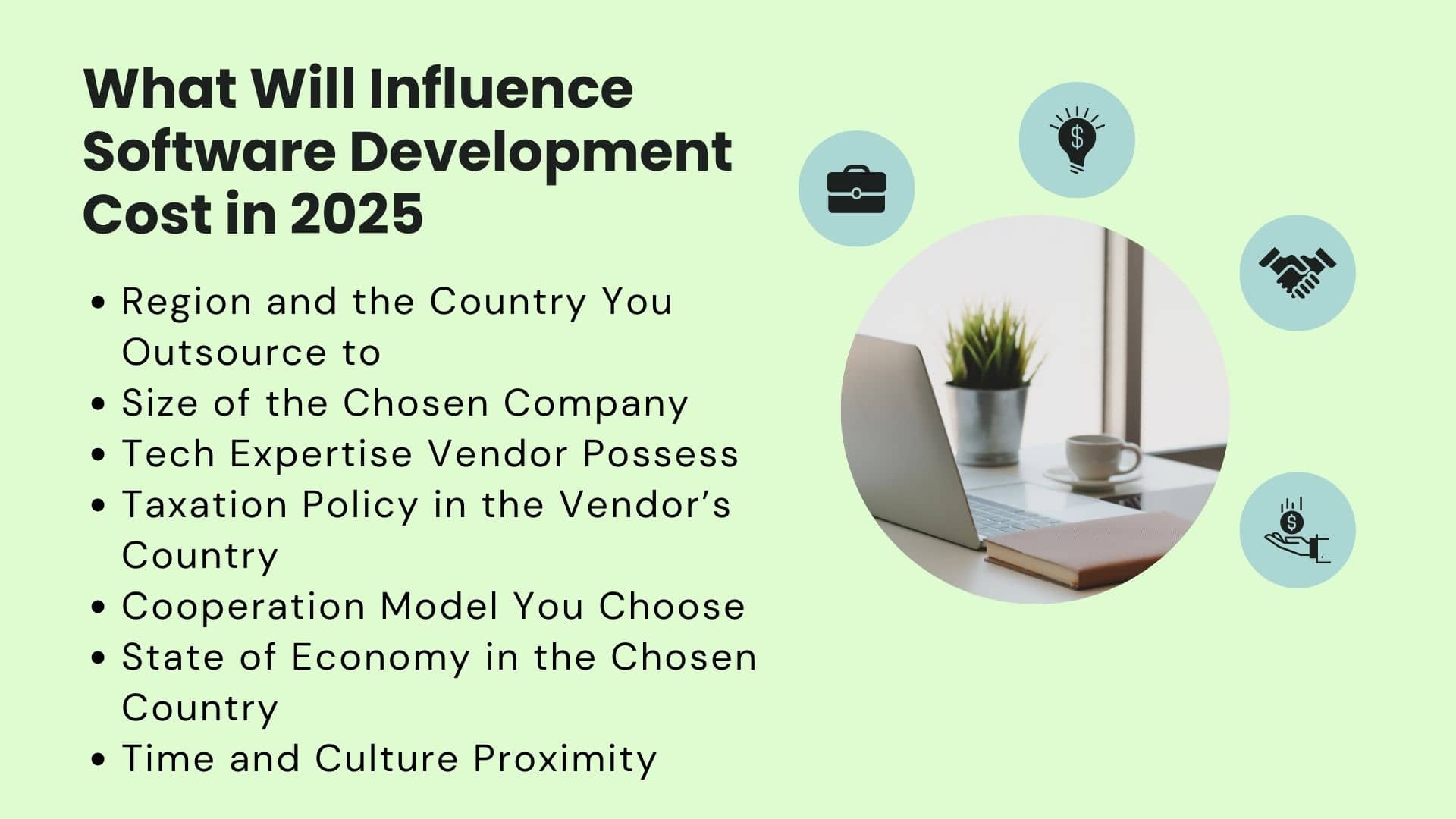
Software vendor management best practices comprise thorough attention to budgeting. To succeed in the software development project, the managers start by analysing the estimated costs. Check, which factors will form the total cost of your product building, no matter which country you choose as an outsourcing destination.
Region and the Country You Outsource to
The average hourly rate of software engineers will differ depending on the country of residence. Traditionally, the experts from Northern America and Western Europe charge more than their colleagues from Eastern Europe, Asia, and Eastern America. While the country impacts the overall project cost a lot, it shouldn’t be the decisive factor.
Size of the Chosen Company
Large software development houses offer competitive rates due to the larger talent base and complex services they provide. Meanwhile, boutique IT vendors can be more flexible in conditions and ready to follow your rules, despite offering a higher rate for software engineers.
Unlock Global Talent with Offshore Development!
Access skilled developers worldwide and achieve high-quality results without overspending.
Tech Expertise Vendor Possess
The need for rare technical expertise influences offshore software development cost drastically. An expert in rare or emerging technologies with practical experience makes the IT vendor’s services more expensive and, thus more valued. The higher demand and tech talent shortage also make prices grow bigger.
Taxation Policy in the Vendor’s Country
Some countries have supportive policies and tax cuts for startups or foreign businesses. It makes these countries attractive for SMEs and companies that only start their way. Others have quite rough tax policies that usually come with greater political and economic stability and a more favourable environment for big businesses.
Why Our Clients Choose Talmatic
Best prices are not the core factor that helps us build long-term mutually beneficial relationships with our clients. We also offer teams with extensive experience in different industries built exclusively to meet your tech challenges. Our analytics work to offer the most cost-effective and efficient tech stack and optimize the team composition. This approach is especially important for complex solutions such as a custom blockchain development service, where industry knowledge and technical precision directly impact project success.
Each of our clients receives a thought-off proposal that considers all the business needs and project peculiarities. For different projects, we’ve provided specialized expertise and built dedicated teams to provide end-to-end services. Our clients claim their success achieved in cooperation with Talmatic, in their stories:
- The US-based client looked for extra expertise to boost their development team. The task was to successfully migrate the existing website to a new platform. Thanks to the well-defined recruitment, onboarding, and development process, we’ve found a candidate within a short time, approved him with a client and helped him onboard. During the phased transition the website was moved to Angular, which improved the business performance of a client and increased customer satisfaction.
- Another client reached us with the idea of creating an application to help people with cognitive disorders and learning disabilities in their daily routines. We’ve analysed the tasks and built a team to complete a project in PHP, and also its mobile versions. We also agreed on release conditions and ongoing support. Our client got a partner that shared their vision, values, and risks.